Published comparisons of RNA fusion callers agree on less than a lab would want. In haematologic cell lines, Arriba, FusionCatcher and STAR-Fusion recover 93% or more of validated driver fusions, but they differ by more than twentyfold in how many unconfirmed calls they leave for review. The baseline is the rule-based genome-alignment approach of STAR-Fusion and Arriba. The only machine-learning caller tested against it on the same data, EricScript, found fewer driver fusions and produced far more unconfirmed calls, and no deep-learning caller has been compared with it. No published multi-caller comparison covers solid tumours or FFPE tissue.
Evidence tables: every comparison in this review, with per-tool values and source details, is on the Tumour RNA fusion detection use case in the Rewire benchmark database.
The practical question is which RNA-seq workflow detects and prioritises tumour gene fusions with useful sensitivity and a manageable number of false calls to review. The answer depends on the input: paired-end short reads from conventional or targeted capture libraries, or long reads; the specimen type; and how many false-positive calls the lab can review by hand. This review covers seven published comparisons across 23 tools. I did not rerun any caller. Values from different studies cannot be pooled, because each study has its own truth set and scoring rule.
How the caller families find a fusion
A gene fusion appears in RNA-seq as sequence that joins two genes. Paired-end short reads give two kinds of evidence. A split read, also called a junction read, crosses the breakpoint, so one part aligns to gene A and the other to gene B. A spanning pair has one mate in each gene, but neither read crosses the junction (Uhrig et al. 2021). A long read can cover the whole fused transcript. The families below differ in which evidence they collect, how they align it and how they filter it.

Read evidence for a fusion and the caller families that use it. Diagram by the author.
Genome alignment of chimeric reads. STAR-Fusion and Arriba take paired FASTQ files, align them to the genome with STAR, and collect STAR's chimeric alignments: split reads and discordant mates (Uhrig et al. 2021). STAR-Fusion reports junction-read and spanning-fragment counts per fusion and by default drops candidates below 0.1 fusion fragments per million reads (FFPM) (Haas et al. 2019). Arriba filters on read support, anchor length, homology between partners and a position-specific blacklist trained on RNA-seq of normal tissue. In a comparison of 23 methods on 56 cancer cell lines, Haas and colleagues found STAR-Fusion, Arriba and STAR-SEQR the most accurate and among the fastest. Haas and colleagues develop STAR-Fusion, so that result is developer-reported.
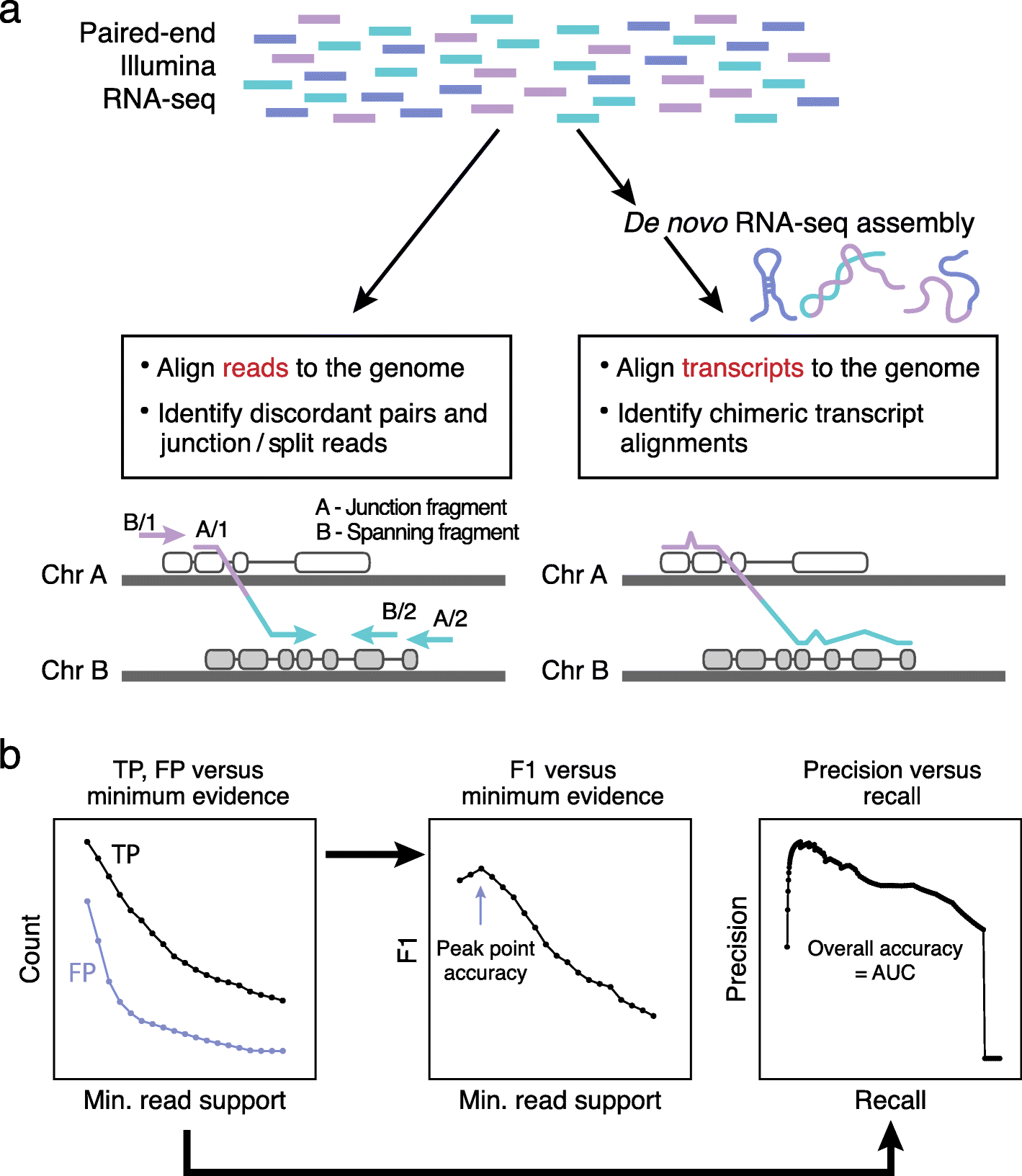
Figure 1 from Haas et al. 2019, Genome Biology, CC BY 4.0. Panel a shows read mapping (junction fragment A, spanning fragment B) and de novo assembly.
Several aligners and databases. FusionCatcher runs Bowtie, BLAT and STAR by default, with Bowtie2 optional, and treats fusions listed in databases of healthy samples as known false positives (FusionCatcher manual). Ensemble pipelines such as EnFusion take a different route: they combine the outputs of separate callers.
Transcriptome alignment and assembly. JAFFA aligns reads, or contigs assembled from them, to a reference transcriptome with BLAT rather than to the genome (Davidson et al. 2015). TrinityFusion assembles transcripts de novo with Trinity. In Haas et al., assembly-based methods had high precision but low sensitivity on simulated reads and ranked among the least accurate, though they can reconstruct fusion isoforms.
Pseudoalignment. pizzly builds on kallisto and inspects read pairs that cannot be pseudoaligned to one transcript because their k-mers match different genes (Melsted et al. 2017, preprint). It then assembles fusion transcripts from those reads. It produces no base-level genome alignment. In the Tamura comparison below it made far more single-caller calls than any other tool.
Long-read callers. Short-read algorithms do not handle the error rates of long reads (Davidson et al. 2022). JAFFAL aligns long reads to the transcriptome with minimap2, keeps reads that align to two genes and confirms them against the genome. LongGF reads a genome alignment BAM and a gene annotation and returns a ranked list of candidates with their supporting reads (Liu et al. 2020). CTAT-LR-Fusion finds candidate chimeric reads with a modified minimap2, realigns them to fusion contigs, and can add matched short-read evidence through FusionInspector (Qin et al. 2025). FusionSeeker and GFSeeker were also scored in the Dorney benchmark below.
Targeted anchored multiplex PCR. Anchored multiplex PCR is a wet-lab enrichment method, not a software caller. Its developers reported that it detects rearrangements without prior knowledge of the fusion partner and works on FFPE input. In 319 FFPE samples they reported 100% sensitivity (95% confidence limit 96.5 to 100%) and 100% specificity against reference assays (Zheng et al. 2014). It only finds fusions involving the genes on the panel. None of the comparisons reviewed here reports per-caller values against it.
Machine-learning filters and prioritisers. Some callers score candidates with a trained classifier: deFuse and EricScript both use AdaBoost (Haas et al. 2019, Table 1). Separate tools rank calls by predicted oncogenic potential. Oncofuse uses protein-domain features (Shugay et al. 2013). DEEPrior uses a convolutional and bidirectional LSTM network trained on 2,118 fusion protein sequences and returns a probability (Lovino et al. 2020). These tools rank fusions that a caller has already found. None of the comparisons reviewed here includes a deep-learning or foundation-model fusion caller.
The baseline
The baseline for this use case is genome alignment of chimeric reads, as done by STAR-Fusion and Arriba. Both align reads to the genome with STAR, then keep or drop candidate fusions with fixed rules on split-read and spanning-pair support, anchor length, partner homology and blacklists. Neither uses a trained classifier. They are the baseline because they were the most accurate methods in Haas et al. (developer-reported), were two of the three callers with the highest driver recall in Tamura's independent comparison, and one or both appears in every short-read study reviewed here. Neither dominates the other: Arriba found more driver fusions in Tamura, and STAR-Fusion made far fewer single-caller calls.
The baseline is not the truth. Truth comes from a reference standard: karyotyping, FISH and RT-PCR in Kim et al., the Seraseq synthetic reference in LaHaye et al., and caller agreement plus literature or RT-PCR support in Tamura et al. A newer method beats the baseline only if it scores better against the same truth on the same data.
| Method | Family | Baseline | Result against the baseline in the same study | Study |
|---|---|---|---|---|
| STAR-Fusion | Genome alignment, rule-based filters | Yes | 57 of 61 conventional driver fusions; 1,061 single-caller calls | Tamura et al. (independent) |
| Arriba | Genome alignment, rule-based filters | Yes | 61 of 61 conventional driver fusions; 9,567 single-caller calls | Tamura et al. (independent) |
| EricScript | Alignment plus AdaBoost classifier | No | Worse on every measure: 49 of 61 conventional and 20 of 24 targeted driver fusions, and 160,271 single-caller calls on conventional RNA-seq | Tamura et al. (independent) |
| EricScript | Alignment plus AdaBoost classifier | No | Least accurate of 23 methods on cancer cell lines, mostly from false positives | Haas et al. (developer-reported) |
| deFuse | Alignment plus AdaBoost classifier | No | Not among the three most accurate methods, all STAR-based; per-method values are in figures only | Haas et al. (developer-reported) |
| Oncofuse | Prioritiser, protein-domain features | No | Never compared; ranks calls rather than detecting fusions | None |
| DEEPrior | Prioritiser, deep learning | No | Never compared; ranks calls rather than detecting fusions | None |
| Deep-learning or foundation-model caller | Not applicable | No | None appears in any comparison reviewed here | None |
EricScript values are from Tamura et al. Supplementary Tables 3 and 5. The Haas statement on EricScript is from the paper's text.
So the only machine-learning detector compared with the baseline on the same data did not beat it. The prioritisers answer a different question, which fusion is likely to drive the cancer, and no study scores them against the baseline's output.
Most resource figures come from the developers of each tool, measured on different hardware and data, so they are not directly comparable. Arriba's developers measured on eight cores: Arriba ran 5.6 times faster than STAR-Fusion on average, its workflow used 38 GB of memory on average, 31 GB of which was the STAR index, and its post-alignment step took at most 6.3 minutes (Uhrig et al. 2021). The STAR-Fusion documentation asks for about 40 GB of RAM when STAR-Fusion runs STAR itself (STAR-Fusion wiki). FusionCatcher needs at least 24 GB (manual). JAFFA took 16 hours and 8 GB on one core for 20 million read pairs (Davidson et al. 2015). In the JAFFAL paper, JAFFAL averaged 2.6 hours and 20 GB on four threads; LongGF averaged 0.4 hours and 6.4 GB on one thread, after a genome mapping step that averaged 9.5 hours. CTAT-LR-Fusion took about 90 minutes and 15 GiB per cell line transcriptome, roughly 50% longer than the other long-read methods its developers tested (Qin et al. 2025). pizzly's developers report runtimes of minutes. All of these run on CPUs. The one comparison that timed many short-read callers on the same hardware is Haas et al., where pizzly and STAR-Fusion's kickstart mode, which reuses an existing STAR alignment, were fastest, followed by other STAR-based methods and FusionCatcher.
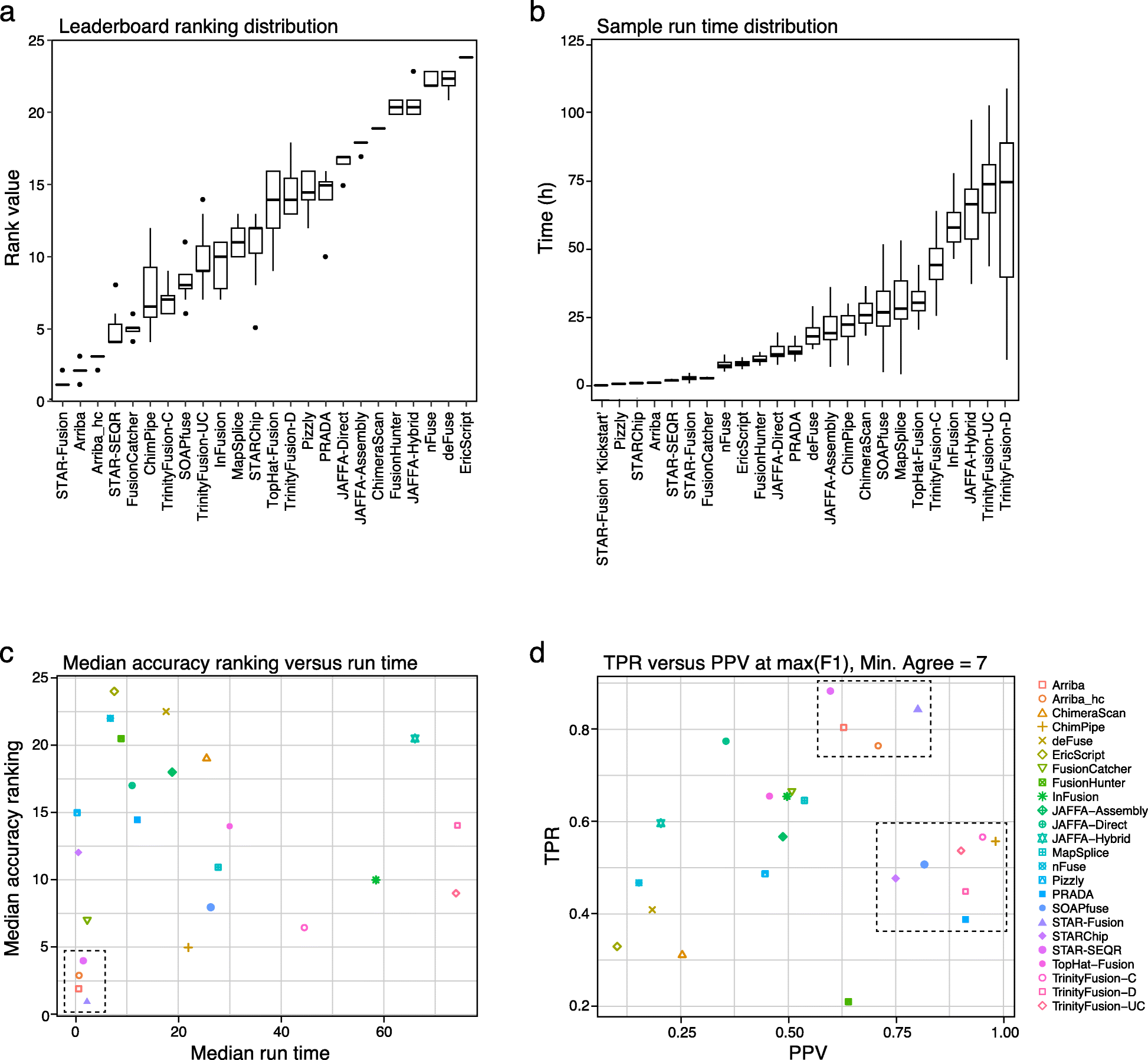
Figure 4 from Haas et al. 2019, Genome Biology, CC BY 4.0. Accuracy and run time on 56 cancer cell lines, single cores except the two slowest methods. The authors develop STAR-Fusion.
| Family (tools) | Accuracy | Reproducibility | Compute | Ease of use | Interpretability |
|---|---|---|---|---|---|
| Genome alignment (STAR-Fusion, Arriba), the baseline | Highest driver recall in Tamura; most accurate in Haas (developer-reported) | Versioned CTAT genome library; Arriba blacklist shipped as separate database files | About 40 GB RAM with STAR; Arriba adds minutes after alignment | Open source (BSD-3, MIT); can reuse an existing STAR alignment | Junction and spanning read counts; FusionInspector; Arriba fusion plots |
| Several aligners (FusionCatcher) | Driver recall 0.98 in Tamura; many single-caller calls | Builds references from a fixed Ensembl release | At least 24 GB RAM | GPL-3; BLAT licence must be checked for commercial use | Calls labelled against known-fusion databases |
| Transcriptome or assembly (JAFFA, TrinityFusion) | High precision, low sensitivity on simulated reads (Haas) | Depends on assembler and reference transcriptome | JAFFA 16 h on one core; Trinity modes slowest in Haas | Multi-step pipelines | Assembled fusion transcripts and isoforms |
| Pseudoalignment (pizzly) | Highest single-caller count in Tamura | Depends on transcript index | Minutes (developer-reported) | BSD-2; needs kallisto first | No genome alignment to inspect |
| Long-read (JAFFAL, LongGF, CTAT-LR-Fusion and others) | F1 0.35 or lower on simulated reads (Dorney, preprint) | Sensitive to read identity and depth | 0.4 to 2.6 h and 6 to 21 GB in the JAFFAL paper | LongGF is GPL-3; needs a long-read library | Whole fused transcript in one read |
| Anchored multiplex PCR | 100% sensitivity on 319 FFPE samples (developer-reported) | Fixed panel design | Wet-lab assay | Requires panel chemistry | Limited to panel genes |
| ML prioritisers (DEEPrior, Oncofuse) | Rank calls; do not detect fusions | DEEPrior can be retrained on user data, which changes scores | Run on caller output, not raw reads | DEEPrior runs in Python 3.7 | Score or probability without read evidence |
Short reads in haematologic cell lines
The largest short-read comparison is by Zen Tamura, Keisuke Kataoka and colleagues at the National Cancer Center Research Institute in Tokyo, published in npj Precision Oncology. They ran 12 callers with default or recommended parameters on conventional RNA-seq of 170 haematologic cancer cell lines and on targeted RNA-seq of 26. They did not develop 11 of the 12 tools. The exception is Genomon, whose fusion paper was first-authored by a co-author, so Genomon results count as developer-reported.
On 61 driver fusion and cell line pairs in conventional RNA-seq, Arriba detected all 61 (true-positive rate 1). FusionCatcher reached 0.98, STAR-Fusion 0.93, InFusion 0.43 and STARChip 0.41. On 24 driver pairs in targeted RNA-seq, run on the authors' own capture panel, Arriba again reached 1, STAR-Fusion 0.92, InFusion 0.17 and STARChip 0. With 24 pairs, one fusion moves the rate by about 0.04.
These rates likely run high. A driver fusion entered the truth set only if at least four callers found it, including the one being scored, and it had literature or RT-PCR support. Fusions that most callers miss are therefore under-represented. Tamura and colleagues also show that changing parameters recovers some missed driver fusions.
Review burden is where the callers separate. The authors counted calls made by one caller and no other, scored against a consensus of the other callers. On conventional RNA-seq that count ranged from 327 for TrinityFusion-D to 695,295 for Pizzly.
| Caller | Driver fusions found, conventional (of 61) | Driver fusions found, targeted (of 24) | Single-caller calls, conventional | Consensus PPV, conventional |
|---|---|---|---|---|
| Arriba | 61 | 24 | 9,567 | 8% |
| FusionCatcher | 60 | 23 | 22,445 | 4% |
| STAR-Fusion | 57 | 22 | 1,061 | 39% |
| Genomon (developer-reported) | 50 | 21 | 1,932 | 26% |
| TrinityFusion-D | 41 | 20 | 327 | 55% |
| InFusion | 26 | 4 | 850 | 24% |
| STARChip | 25 | 0 | 191 | 44% |
| Pizzly | 51 | 22 | 695,295 | 0% |
| EricScript (AdaBoost classifier) | 49 | 20 | 160,271 | 0% |
Selected rows from Tamura et al. 2026 (Supplementary Tables 3 and 5), haematologic cell lines only. PPV is against a consensus of other callers, not a validated truth set.
The single-caller counts measure disagreement, not error. A call made by one caller alone may be a real fusion that the others missed, and calls made by two or three callers count as neither true nor false. The PPV column is therefore not precision against confirmed fusions. It does show how many calls a reviewer would face. Among the three callers with the highest driver recall, that number differs by a factor of more than 20.
A reference standard and a paediatric cohort
Stephanie LaHaye, Peter White and colleagues at the Institute for Genomic Medicine, Nationwide Children's Hospital, published an earlier comparison in BMC Genomics in 2021. They report results for Arriba, STAR-Fusion and their own ensemble, EnFusion, so the EnFusion values are developer-reported.
On undiluted duplicate libraries of a 14-fusion Seraseq synthetic reference, STAR-Fusion found all 14 at 43.6% precision, and Arriba found 13 at 55.3%. The three-caller EnFusion ensemble found all 14 at 90.3%. Adding a filter and a known-fusion list raised precision to 100%. That last configuration uses prior knowledge of the reference fusions, so its perfect score is an optimisation result, not an estimate of performance on new samples. All non-Seraseq calls were counted as false, although some may be real background fusions.
In a cohort of 229 paediatric cancer and haematologic samples, STAR-Fusion recovered 63 of 67 clinically relevant fusions (94.0%) and Arriba 59 (88.1%). The 67 fusions were ascertained by the optimised EnFusion pipeline itself. The denominator is not an independent, exhaustive truth set, so a false-negative rate for fusions the ensemble missed cannot be derived.
The paper also contains two internal inconsistencies. It prints STAR-Fusion precision as both 43.6% and 43.8%, and its Table 2 caption (v3) disagrees with its optimisation narrative (v2).
The only comparison against clinical assays
Hyun-Young Kim, Hee-Jin Kim and colleagues at Samsung Medical Center and Sungkyunkwan University School of Medicine, Seoul, compared whole RNA-seq with conventional diagnostics in 101 adult and paediatric acute leukaemia patients, in Annals of Laboratory Medicine. Their workflow used Arriba with manual review in IGV. Truth was karyotyping, FISH and multiplex RT-PCR.
The workflow detected 40 of 48 conventionally detected fusions, a sensitivity of 83.3%. Overall agreement across 104 fusion detection results was 80.8%. It also called fusions in 21.4% of 56 conventionally negative results. These 12 RNA-seq-only calls count against specificity, but the authors describe several as well-known recurrent fusions, and they confirmed one, MLLT10::UBE2L6, by RT-PCR and Sanger sequencing.
This is direct evidence, but narrow. It is one workflow at one centre, with no other caller for comparison. Because every call was reviewed by hand, it does not measure the false-call burden of raw Arriba output. The authors attribute missed fusions to low blast proportion, subclonality, poor aspirates, complex rearrangements or enhancer hijacking rather than to the caller alone.
Long reads: low accuracy in an independent benchmark
Two studies cover long-read callers. John Lin, Jeremy Wang and colleagues at the University of North Carolina at Chapel Hill scored four callers on nanopore whole-transcriptome sequencing of paediatric B-ALL, in The Journal of Molecular Diagnostics. Scoring used the dominant fusion per sample among 74 listed B-ALL fusions, against clinical subtypes from cytogenetics, FISH and short-read RNA-seq.
At high depth (11.2 M reads, 51 samples), JAFFAL reached sensitivity 0.76, LongGF 0.70 and FusionSeeker 0.63, with precision from 0.79 to 0.95. FUSILLI, developed by the same authors, reached 0.81. At low depth (1.4 M reads), sensitivity fell to between 0.09 and 0.27. Calls outside the 74-fusion list were not scored, so this does not measure review burden.
Ryley Dorney, Ulf Schmitz and colleagues at James Cook University, Australia, posted an independent benchmark of six long-read callers as a bioRxiv preprint. They developed none of the callers, and the work has not been peer reviewed.
On 400 simulated fusions at 100 Gb and 95% read identity, no caller exceeded F1 0.35.
| Caller | F1 | Recall | Precision | MCF7 known fusions matched (of 53) | MCF7 other calls |
|---|---|---|---|---|---|
| CTAT-LR-Fusion | 0.35 | 28.25% | 45.7% | 20 | 51 |
| JAFFAL | 0.29 | 24.75% | 35.2% | 19 | 38 |
| Genion | 0.20 | 16.75% | 24.9% | not shown | not shown |
| FusionSeeker | 0.14 | 20% | 10.2% | 11 | 359 |
| GFSeeker | 0.07 | 10.5% | 5.19% | not shown | not shown |
| LongGF | 0.04 | 2.75% | 9.40% | not shown | not shown |
Dorney et al. 2026 (preprint). F1, recall and precision on simulated reads at 100 Gb and 95% read identity. MCF7 counts are from all ONT PCR-cDNA reads.
The simulated fusions are synthetic and mostly not cancer drivers. On the MCF7 cell line, the known list comes from the literature, so "other calls" mix real unlisted fusions with false calls. The matched counts are an upper bound, because the authors' script does not deduplicate call records to listed fusions.
Dorney and colleagues also sequenced the Huh7 cell line on three platforms and pooled callers per platform: six long-read callers for each long-read platform and three short-read callers for Illumina. PacBio Kinnex recovered 20 of 34 previously reported fusions, ONT PCR-cDNA 17 and Illumina 15. This compares platforms, not individual callers. None of the three Huh7 fusions validated by RT-PCR or Sanger sequencing was detected by any library.
Why some studies only partly answer the question
Two of these comparisons do not use an independent truth set. Tamura's analysis of all fusions scores each caller against a consensus of the other callers. The Dorney benchmark scores against simulated reads and a literature list. Both show how callers behave relative to each other. Neither shows how often a call is right in a patient sample.
The other studies have their own limits. The Tamura driver set draws its denominator partly from the callers under test, and the Nationwide Children's cohort draws its denominator from the ensemble pipeline. Lin et al. score one fusion per sample. Kim et al. evaluate a single workflow.
What has not been measured
- Several callers have not been compared on adult solid tumours or FFPE tissue with per-caller values in tables. A 2026 Br J Cancer study of 1,233 FFPE solid tumours reports Arriba and DRAGEN against panel assays only in figures.
- Sensitivity for fusions that most callers miss has not been measured, because the Tamura driver truth sets depend on caller agreement. None of these studies assesses novel-fusion discovery.
- Tamura et al. show per-caller results on 165 clinical haematologic samples only in a figure.
- Short- and long-read evidence on the same RNA comes from one cell line, with calls pooled per platform.
- Haas et al. 2019 prints per-method accuracy only in figures. I have not included results from the DREAM SMC-RNA fusion challenge.
- No study reports interval estimates for per-caller sensitivity or precision.
- No deep-learning or foundation-model fusion caller has been compared with STAR-Fusion or Arriba on the same data, and no study scores the prioritisers Oncofuse or DEEPrior against them.
- Long-read precision and recall come from simulated reads only.
What this means for choosing and validating a caller
On current evidence, Arriba, FusionCatcher and STAR-Fusion give similar driver recall in haematologic short-read data. They differ mainly in how many unconfirmed calls they produce. STAR-Fusion produced the fewest single-caller calls of the three in Tamura's data. Arriba was the only caller tested against clinical assays, and then only with manual review. Long-read callers have not matched short-read callers in the one independent benchmark, though that benchmark is a preprint and uses simulated reads.
Because none of these studies establishes clinical performance, a lab adopting any caller still needs its own validation on its own specimen type, ideally against orthogonal assays and with the review burden counted before manual filtering.
What would change the picture
Three kinds of study would help most. The first is a multi-caller comparison on FFPE solid tumours against orthogonal assays, with per-caller values in tables. The second is a truth set not ascertained by the callers being scored, so that sensitivity for hard fusions can be measured. The third is any of the above with confidence intervals, and with review burden counted before manual review rather than after it.
Until then, the evidence describes caller behaviour in haematologic cell lines, a paediatric cohort, B-ALL and acute leukaemia. None of it establishes clinical performance.
Per-tool values and source details for every study above are in the Tumour RNA fusion detection use case.
Help improve this article
Found an error or a better source? Leave a note here, or highlight a passage to comment on it.