Short-read genome callers find most deletions larger than 10 kb in reference samples, but small deletions, duplications and exome data remain weak points. In the DRAGEN developers' benchmark, depth-based callers found at most 26% of 1 to 5 kb deletions; adding split-read evidence recovered 87%. There is no reliable evidence that a machine-learning caller beats the read-depth baseline on the same data.
Evidence tables: every comparison in this review, with per-tool values and source details, is on the CNV detection and characterisation use case in the Rewire benchmark database.
The practical question for a diagnostic laboratory is which workflow detects germline copy-number variants (CNVs) from exome, panel or genome data accurately enough to complement or replace chromosomal microarray (CMA) and multiplex ligation-dependent probe amplification (MLPA), and how the resulting calls should be classified and reviewed. Accuracy here has three parts: recall of true CNVs at the sizes that matter clinically, the number of false calls that must be confirmed or reviewed, and agreement with expert classification once a CNV is found.
This review covers six published comparisons: four of germline detection on genomes, one on clinical exomes, and one of automated ACMG classifiers. I did not rerun any tool. Each study has its own truth set and matching rule, so values from different studies cannot be pooled.
How the caller families find a copy-number change
A deletion or duplication leaves three kinds of trace in short-read data. Read depth falls or rises across the affected bases. Read pairs that span a breakpoint map with the wrong insert size or orientation. Reads that cross the breakpoint split between two locations. A caller's family is defined by which of these traces it uses.
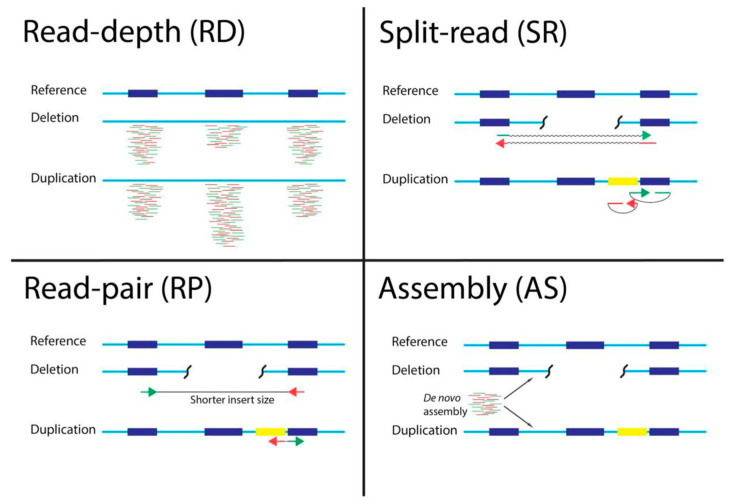
Figure 1 from Gabrielaite et al. 2021, Cancers, CC BY 4.0. Read depth (RD), split reads (SR), read pairs (RP) and assembly (AS) as evidence for a deletion and a duplication.
Read-depth statistical callers. These count reads per exon or genomic bin, correct for GC content and mappability, and compare the counts with a reference built from other samples or from the same genome. ExomeDepth builds a matched reference set from other exomes in the same batch and fits a beta-binomial model. CNVkit uses on-target and off-target bins and segments log ratios. CoNIFER removes the strongest shared components of exon depth with singular value decomposition. cn.MOPS models depth across many samples as a mixture of Poisson distributions. GATK gCNV fits a Bayesian model of read counts that learns sample and region biases from a cohort. For genomes, CNVnator bins depth and segments it, and Control-FREEC segments depth ratios. These callers see the span of a CNV but not its exact breakpoints, and they lose power when a CNV covers few exons or bins.
Paired-end and split-read SV callers. DELLY, LUMPY and Manta are structural-variant callers that report deletions and duplications from discordant pairs and split reads. They resolve breakpoints and can find events of a few hundred bases. They also report many calls that a depth signal does not support, and duplications in repeats are hard for them.
Combined callers. DRAGEN 4.2 runs a depth-based CNV caller and uses its own SV calls to refine CNV breakpoints (Behera et al. 2024). It is part of an FPGA-accelerated commercial platform. Parliament2 combines the outputs of several callers. GATK gCNV and DRAGEN CNV are not machine-learning methods in the sense used below; both fit statistical models to the sample at hand.
Deep learning. Cue converts alignment signals around candidate regions into multi-channel images and detects SV breakpoints with a convolutional network (Popic et al. 2023). The model evaluated below was trained on events of 5 kb and larger. ECOLE applies deep learning to exome CNV calling, but its published evaluation uses CNVnator calls as truth (Mandiracioglu et al. 2024), so it is not a comparison against an orthogonal reference.
Long-read callers. PacBio and nanopore reads span repeats and breakpoints that short reads cannot. Sniffles2, pbsv with HiFiCNV, cuteSV and dysgu were among the tools in Nardone et al. 2025. That paper's input conditions and tables are inconsistent (see below), so its long-read results are not used here.
Genomic foundation models. No published study has applied a DNA foundation model, such as Evo 2 or the Nucleotide Transformer, to CNV detection. These models score sequence. CNV detection from short reads is a counting and segmentation problem across samples, so there is no obvious place for a sequence-likelihood score in the detection step.

Evidence types, caller families and the steps after calling. Diagram by the author.
Classification. Once a CNV is called, it is classified under the ACMG and ClinGen framework. AnnotSV and ClassifyCNV implement the guideline scoring as rules. X-CNV and dbCNV are XGBoost classifiers trained on labelled CNVs from public databases. MarCNV-ISV combines rule-based ACMG evidence with predictions from the ISV boosted-tree model (Zhang et al. 2026).
The baseline
For detection, the baseline is a read-depth statistical caller: ExomeDepth for exomes and CNVnator for genomes. ExomeDepth is the established exome caller in diagnostic pipelines, and the authors of the exome study below describe earlier workflows built around it. CNVnator is the read-depth genome caller that appears in all four genome comparisons covered here. Neither uses a trained classifier. For classification, the baseline is rule-based ACMG scoring as implemented in AnnotSV and ClassifyCNV.
The baseline is not the truth. Truth comes from a reference standard: CMA in the exome study, MLPA for 12 events in Gabrielaite et al., the Genome in a Bottle (GIAB) structural-variant set for the HG002 cell line, a consensus call set for NA12878, and expert ACMG classification for the classifier study. A method beats the baseline only if it scores better than the baseline against the same truth on the same data.
| Method | Type | Baseline | Result against the baseline in the same study | Study |
|---|---|---|---|---|
| ExomeDepth | Read depth, beta-binomial | Yes (exome) | Exon sensitivity 0.758, PPV 0.025 | Hwang et al. 2026 (independent) |
| CoNIFER | Read depth, SVD normalisation | No | Similar sensitivity (0.768), higher PPV (0.239); statistical, not machine learning | Hwang et al. 2026 (independent) |
| CNVnator | Read depth, segmentation | Yes (genome) | HG002 deletion recall 0.264 at 1 to 5 kb and 0.916 to 0.982 above 10 kb; NA12878 recall 0.434, precision 0.128 | Behera et al. 2024 (DRAGEN developers); Gabrielaite et al. 2021 (independent) |
| Cue | Deep learning on alignment images | No | Values not reliable (text and tables disagree) | De La Vega et al. 2025 |
| ECOLE | Deep learning, exome | No | No comparison against an orthogonal truth set | None |
| ClassifyCNV | Rule-based ACMG scoring | Yes (classification) | Five-category accuracy 67.80%, PPV 52.28% | Zhang et al. 2026 (independent) |
| AnnotSV | Rule-based ACMG scoring | Yes (classification) | Five-category accuracy 60.21%, PPV 39.96% | Zhang et al. 2026 (independent) |
| X-CNV | XGBoost | No | Accuracy 48.76%, PPV 37.00%; lowest on both | Zhang et al. 2026 (independent) |
| dbCNV | XGBoost | No | Accuracy 66.58%, PPV 40.87% | Zhang et al. 2026 (two authors developed dbCNV) |
| MarCNV-ISV | Rules plus boosted trees | No | Accuracy 69.81%, PPV 46.81%; about two points above ClassifyCNV on accuracy, lower on PPV | Zhang et al. 2026 (independent) |
| Genomic foundation model | Not applicable | No | None evaluated | None |
Hwang values are from Table 4, before the authors' region filter. CNVnator values are from Behera et al. 2024, Supplementary Table S4, and Gabrielaite et al. 2021, Table S2; they are not a same-data comparison with Cue. Zhang values are from Table 3; the paper does not state how the five classes are averaged.
Cue is the only deep-learning CNV caller with a same-data comparison against CNVnator, but that comparison's numbers are internally inconsistent in the source, so there is currently no reliable evidence that a deep-learning caller beats the read-depth baseline. The two machine-learning classifiers did not exceed rule-based scoring. None of these comparisons reports confidence intervals, so differences of a few points cannot be separated from sampling noise.
| Family (tools) | Accuracy | Reproducibility | Compute | Ease of use | Interpretability |
|---|---|---|---|---|---|
| Read depth, exome (ExomeDepth, CNVkit, CoNIFER, cn.MOPS), the exome baseline | Exon sensitivity 0.17 to 0.77 against CMA; PPV 0.025 to 0.239 (Hwang) | Depends on the reference set of other samples, capture kit and batch | Batch callers hold many alignments in memory (Gabrielaite) | Open source; needs a matched batch of exomes | Depth ratios per exon; no breakpoints |
| Read depth, genome (CNVnator, Control-FREEC, GATK gCNV), the genome baseline | CNVnator recall 0.92 to 0.98 above 10 kb, 0.26 at 1 to 5 kb (DRAGEN paper) | gCNV needs a cohort model; CNVnator works per sample | Control-FREEC lowest memory and CPU; gCNV high peak memory (Gabrielaite) | Open source | Depth plots; approximate boundaries |
| Paired-end and split-read (DELLY, LUMPY, Manta) | Recall 0.88 to 0.94, precision 0.20 to 0.33 on NA12878 (Gabrielaite) | Calls change with aligner and insert-size distribution | Manta low memory and fast; DELLY slow (Gabrielaite) | Open source | Supporting read counts and breakpoints |
| Combined (DRAGEN 4.2 CNV with SV) | Recall 0.87 to 1, precision 0.99 to 1 on HG002 deletions (developer-reported) | Versioned commercial software | FPGA-accelerated; licensed | Integrated in one pipeline | Depth and junction support labelled per call |
| Deep learning (Cue) | Values not reliable; the only same-data study's text and tables disagree (De La Vega) | Fixed trained model; behaviour outside training sizes undefined | Not reported in these studies | Open source | Image-derived score; no depth ratio |
| Long-read (Sniffles2, pbsv with HiFiCNV, cuteSV, dysgu) | No reliable comparison in these studies | Depends on read accuracy and depth | Not compared in these studies | Needs a long-read library | Single reads span breakpoints and repeats |
| Classification, rule-based (AnnotSV, ClassifyCNV), the classification baseline | Five-category accuracy 60.21% to 67.80% (Zhang) | Deterministic given database versions | Runs on coordinates | Command line or web | Lists the ACMG criteria applied |
| Classification, machine learning (X-CNV, dbCNV, MarCNV-ISV) | Accuracy 48.76% to 69.81% (Zhang) | Depends on training data release | Runs on coordinates | Web or command line | Score without a criterion-level explanation, except the rule part of MarCNV-ISV |
Genome deletions in reference samples
The most detailed size-stratified result comes from the DRAGEN paper by Sairam Behera, Fritz Sedlazeck and colleagues at Baylor College of Medicine and Illumina, published in Nature Biotechnology. Its Supplementary Table S4 scores DRAGEN 4.2 in two modes and CNVnator on 35x HG002 genome data against GIAB SV v0.6 deletions longer than 1 kb. DRAGEN is the authors' product, so these results are developer-reported.
| Deletion size | DRAGEN 4.2 CNV with SV: recall, precision | DRAGEN 4.2 CNV only: recall, precision | CNVnator: recall, precision |
|---|---|---|---|
| 1 to 5 kb | 0.873, 0.986 | 0, 0 | 0.264, 0.752 |
| 5 to 10 kb | 0.933, 1 | 0.01, 0 | 0.505, 0.796 |
| 10 to 20 kb | 0.888, 1 | 0.888, 1 | 0.972, 0.98 |
| 20 to 50 kb | 0.909, 1 | 0.85, 0.967 | 0.916, 0.984 |
| Over 50 kb | 1, 1 | 0.996, 0.996 | 0.982, 0.998 |
Behera et al. 2024, Supplementary Table S4. One sample; per-bin truth and call counts are not reported.
The CNV-only mode is the useful control. With depth evidence alone, DRAGEN found none of the 1 to 5 kb deletions and 1% of those at 5 to 10 kb. With SV breakpoints added, it found 87% and 93%. Above 10 kb, depth alone was enough, and CNVnator matched or exceeded DRAGEN. This is one healthy genome, deletions only, with no counts behind the fractions, so the 10 kb threshold is approximate.
A consensus truth set and eight genome callers
Migle Gabrielaite, Frederik Otzen Bagger and colleagues at Rigshospitalet, University of Copenhagen, compared 11 tools in Cancers in 2021. They developed none of them. On NA12878 genome data, scored against 2,076 consensus CNVs from 51 bp to 453 kb with a 1 bp overlap rule, the SV callers recalled the most and the depth callers the least.
| Caller | Family | Recall | Precision | True positives | False positives |
|---|---|---|---|---|---|
| LUMPY | Split read and pairs | 0.941 | 0.310 | 1,953 | 4,347 |
| DELLY | Split read and pairs | 0.904 | 0.199 | 1,876 | 7,561 |
| Manta | Split read and pairs | 0.875 | 0.326 | 1,817 | 3,753 |
| CNVnator | Read depth | 0.434 | 0.128 | 902 | 6,168 |
| GATK gCNV | Read depth, Bayesian | 0.232 | 0.019 | 482 | 25,493 |
| cn.MOPS | Read depth | 0.170 | 0.123 | 352 | 2,521 |
| Control-FREEC | Read depth | 0.107 | 0.267 | 222 | 610 |
| CLC Genomics Workbench | Read depth, commercial | 0.012 | 0.667 | 24 | 12 |
Gabrielaite et al. 2021, Table S2, NA12878 genome rows. A call counts as true if it overlaps a truth CNV by 1 bp.
Two features of the truth set shape this table. Half of the NA12878 CNVs are shorter than 500 bp, a size that depth callers rarely resolve. And Manta and CNVnator were used to build the truth set, which the authors note can favour them. The 1 bp overlap rule is lenient, and the stated formula does not require the call to match deletion or duplication.
GATK gCNV shows how much the truth set matters. On NA12878 it recalled 23% of CNVs and made 25,493 false calls. Across all 39 genomes, most of them scored against SNP-array CNVs, the authors report it had the best recall of any tool. Arrays miss many short CNVs, while half the NA12878 truth set is below 500 bp, so the two truth sets reward different size ranges. The callers also disagreed with each other: of 407,671 CNVs called across the 38 genomes, 74.4% were called by one tool only.
The same paper adds a small orthogonal check. Twelve CNVs confirmed by MLPA, from one exon to a whole gene, were tested in six exomes and six genomes. GATK gCNV, cn.MOPS, CNVnator and Control-FREEC found all of those in the genome samples; ExomeDepth, DELLY, LUMPY and Manta found none. The authors also found that filtering on each tool's own confidence score gave no useful threshold for controlling precision.
Clinical exomes against microarray
The closest study to a diagnostic laboratory's question is by Jinha Hwang and colleagues at Korea University College of Medicine, in Genes in 2026. They had exomes and CMA for 44 of 180 patients. After keeping CMA CNVs with at least ten probes that overlap exome baits and removing artefacts by manual review, 98 CNVs (39 deletions and 59 duplications, 5.03 kb to 6.91 Mb) in 39 patients remained, covering 2,058 deleted and 730 duplicated exons. Scoring was per exon, and any called exon outside the truth set counted as false.
| Caller | Sensitivity, default | PPV, default | Sensitivity, after region filter | PPV, after region filter | Reference exons after filter |
|---|---|---|---|---|---|
| ExomeDepth | 0.758 | 0.025 | 0.903 | 0.102 | 2,124 |
| CNVkit | 0.662 | 0.096 | 0.680 | 0.219 | 2,710 |
| CoNIFER | 0.768 | 0.239 | 0.771 | 0.250 | 2,713 |
| cn.MOPS | 0.170 | 0.041 | 0.162 | 0.144 | 2,723 |
Hwang et al. 2026, Table 4. Default calls are scored on 2,788 reference exons. Deletion and duplication exons are scored together.
ExomeDepth recovered as many exons as CoNIFER but made 83,135 false-positive exon calls, against 6,838 for CoNIFER. The authors then defined, for each tool, the regions where it called a CNV in more than 10% of the 180-exome cohort. More than 80% of these problematic probes overlapped segmental duplications, against 5.2% elsewhere, and they had lower mappability and higher depth variability. Removing calls in those regions cut ExomeDepth's false-positive exons to 16,797.
The four callers were complementary. Of the 98 CMA CNVs, 80 were found by at least one caller, only 15% of true-positive exons were found by all four, and the union of the four reached a sensitivity of 85.71% (Hwang et al. 2026, Results 3.1). Every exon that cn.MOPS detected was also detected by another tool. False-positive calls had lower mappability and higher depth variability than true ones in every caller.
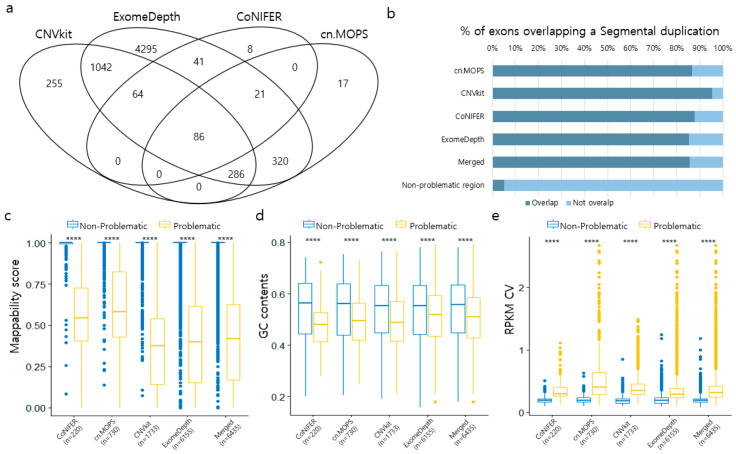
Figure 2 from Hwang et al. 2026, Genes, CC BY 4.0. Problematic exons per caller (a), overlap with segmental duplications (b), and mappability, GC content and depth variability (c to e).
The filtered results need care. The filter is the authors' method, it was defined on the same cohort that includes the 39 scored exomes, and it removes reference exons as well as calls, so post-filter sensitivity is on a smaller set. The filtered regions include probes in 404 clinically relevant genes, among them PMS2 and SMN1, where the authors recommend confirming any candidate by MLPA or CMA. The paper's abstract says every tool improved, but cn.MOPS sensitivity fell from 0.170 to 0.162. The CMA truth set also cannot contain CNVs smaller than ten probes, so some exome "false positives" may be real.
Clinical-panel framing from a vendor-linked group
Francisco De La Vega and colleagues at Tempus AI, with co-authors from Illumina, compared eight genome caller configurations in Bioinformatics Advances in 2025. These included DRAGEN in several modes, Delly, Lumpy, Parliament2, CNVnator and the deep-learning caller Cue. They scored calls on HG002 against a truth set of deletions and duplications that overlap coding exons, many of them synthetic gene models placed by the authors, and on a clinical panel of 25 cell lines. A call counted as true if it overlapped an exon with the right dosage direction.
The published values from this study cannot yet be relied on, because the paper's text and tables disagree. The Results text says CNVnator could not detect 1 to 5 kb events, while Supplemental Table 3 reports CNVnator detections in that size range. The text names Delly as the least precise caller, while the same table gives Lumpy lower precision. It is unclear which version is correct, so I do not quote the values. The DRAGEN results also come from authors who include Illumina employees, and the artefact filter was designed on the same genes, which the authors say may overfit.
Nardone et al. 2025, a group at the University of Trieste, IRCCS Burlo Garofolo and the software company enGenome, compared ten short-read SV callers on HG002 deletions. Its values cannot yet be relied on either. The paper gives inconsistent descriptions of the read depth and aligner behind Table S1, and its text and table disagree on the inGAP result, so I do not quote its per-caller values or rankings.
Classifying a detected CNV
Yingying Zhang, Xiuming Zhang and Dayang Chen, at Shantou University Medical College and the Third Affiliated Hospital of Shenzhen University, ran five automated classifiers on 3,031 CNVs with expert ACMG labels, in Global Medical Genetics in 2026. The set has 2,125 duplications and 906 deletions, drawn from published neurodevelopmental, pregnancy-loss and prenatal cohorts and from the authors' laboratory. Two of the three authors also developed dbCNV, so its results are developer-reported, and the benchmark includes cases from the laboratory where dbCNV was built.
Five-category accuracy was 69.81% for MarCNV-ISV, 67.80% for ClassifyCNV, 66.58% for dbCNV, 60.21% for AnnotSV and 48.76% for X-CNV. The paper does not state how these per-class values are averaged. With benign and likely benign merged, and pathogenic and likely pathogenic merged, AnnotSV classified 95.16% of pathogenic deletions as pathogenic but 86.39% of pathogenic duplications. ClassifyCNV kept 94.92% and 95.74% of VUS duplications and deletions as VUS, while X-CNV kept 23.48% and 1.22%. The authors attribute ClassifyCNV's behaviour to automating only about half of the ACMG criteria, which leaves many CNVs at VUS.
This study evaluates classification of coordinates, not detection from reads. Its reference is expert judgement, which varies between reviewers, and some tools were trained on public databases that may overlap the published cohorts used as reference.
How calls are reviewed
None of these studies measures how an analyst's accuracy depends on the way evidence is shown. Two describe what review involves. Hwang and colleagues built their CMA truth set partly by manually reviewing log2 ratios and B-allele frequencies. De La Vega and colleagues added events to their cell-line truth set after inspecting coverage plots, and used the same plots to explain false positives.
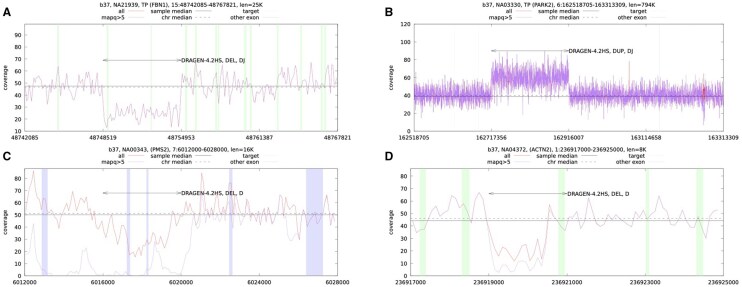
Figure 5 from De La Vega et al. 2025, Bioinformatics Advances, CC BY 4.0. Coverage in 100 bp bins around DRAGEN calls; "D" marks depth support and "J" junction-read support.
The figure shows the two failure modes a reviewer must catch: depth artefacts from paralogous sequence, as at PMS2, and breakpoints placed wrongly by a real call. A call supported by both depth and junction reads is easier to accept than one supported by either alone.
Who measured what
| Study | Data and truth | Callers or tools | Relationship to tools | Status |
|---|---|---|---|---|
| Behera et al. 2024 | HG002 35x genome; GIAB SV v0.6 deletions over 1 kb | DRAGEN 4.2 (two modes), CNVnator | Developers of DRAGEN | Peer reviewed |
| Gabrielaite et al. 2021 | NA12878 genome; 2,076 consensus CNVs; 12 MLPA events | 8 genome callers in the main table | Independent | Peer reviewed |
| Hwang et al. 2026 | 39 clinical exomes; CMA CNVs | ExomeDepth, CNVkit, CoNIFER, cn.MOPS | Independent; region filter is their own | Peer reviewed |
| De La Vega et al. 2025 | HG002 genome, exon-overlapping truth with synthetic genes; 25-cell-line clinical panel | 8 configurations including Cue | Includes Illumina employees for DRAGEN | Peer reviewed; text and tables disagree |
| Nardone et al. 2025 | HG002 genome; GIAB Tier 1 deletions | 10 short-read SV callers | Includes a software company | Peer reviewed; input conditions and text and tables disagree |
| Zhang et al. 2026 | 3,031 expert-classified CNVs | 5 ACMG classifiers | Two authors developed dbCNV | Peer reviewed |
What has not been measured
- No comparison with printed per-caller values covers somatic or tumour CNVs. The SEQC2 HCC1395 benchmark (Genome Biology 2024) reports caller accuracy only in figures.
- Duplications are poorly measured. The genome evidence rests on a few HG002 duplication events in one study whose text and tables disagree, and the exome study scores deletion and duplication exons together.
- No multi-caller long-read CNV benchmark with per-caller values in tables was covered here.
- No study reports confidence intervals for sensitivity or precision.
- The genome results covered here come from reference cell lines. None tests patient genomes against CMA or MLPA with several callers and printed per-caller values.
- No deep-learning caller has been compared with the read-depth baseline outside one study whose text and tables disagree, and no genomic foundation model has been evaluated.
- No study measures how evidence visualisation or review tools change an analyst's accuracy or time per case.
- Hard loci such as PMS2, SMN1 and CYP2D6 need dedicated callers, and none of these comparisons evaluates them.
What this means for choosing and validating a workflow
On current evidence, genome sequencing with a caller that combines depth and breakpoint evidence recovers deletions above about 1 kb in a reference genome better than read depth alone. For exomes, read-depth callers recover most exons in CMA-detected CNVs but produce many false exon calls, and the number depends heavily on the caller and on recurrently miscalled regions. Automated ACMG classifiers agree with expert five-category labels for about half to seven tenths of CNVs. That level supports triage, not replacement of review.
I would not choose an exome caller on sensitivity alone. ExomeDepth and CoNIFER had the same sensitivity in the Hwang cohort and differed by a factor of ten in PPV. A laboratory's own validation should count false calls per sample before manual review, report duplications separately from deletions, and include known positives at PMS2, SMN1 and other paralogous loci.
What would change the picture
Three studies would help most. The first is an independent multi-caller comparison on patient exomes and genomes with CMA and MLPA truth, reporting deletions and duplications separately with confidence intervals. The second is a same-data comparison of deep-learning callers, such as Cue and ECOLE, with ExomeDepth, GATK gCNV and CNVnator across the full size range. The third is a study of analyst review itself: how often reviewers accept false calls or reject true ones with different evidence displays.
Until then, the evidence supports confident deletion calling above roughly 10 kb from short-read genomes, weaker performance below that size and for duplications, and no demonstrated advantage for machine learning over the read-depth baseline.
Per-tool values and source details for every study above are in the CNV detection and characterisation use case.
Help improve this article
Found an error or a better source? Leave a note here, or highlight a passage to comment on it.